For the newly-established Church of England, each new Church Year was to begin with First Sunday in Advent. The name Advent comes from the Latin adventus, which means arrival, or, in the Church context, coming. First Sunday in Advent is always on the Sunday which is closest to Nov. 30, which is also the first “Holy Day” in “The Order for The Administration of the Lord’s Supper or Holy Communion.” The canonical list of saints honored with Holy Days begins with “Saint Andrew the Apostle” on page 226, 1928 Book of Common Prayer. The list of Holy Days begins immediately after “The Collects, Epistles, and Gospels To be used through the Year“
As a season on the Church calendar both the date of its start and its purpose have changed over the centuries. The earliest known use of the name appeared in the 4th C. In the 21st C. both the Roman Catholic and Anglican Church calendars begin on the same date with First Sunday in Advent. For more on the history of Advent season, see the introductory paragraph on Advent in Massey Shepherd’s The Oxford American Prayer Book Commentary, Oxford University Press, 1950. The volume is available on several online sites.
The Collect for First Sunday in Advent is an original composition by Archbishop Thomas Cranmer based largely on verse 12 in the Epistle reading, Romans 13:8-14. Many of St. Paul’s epistles to the newly-founded churches contain similar references to both martial and spiritual themes, especially “the armour of light,” “works of darkness,” “come again,” and “the quick and the dead.” The strong sense of immediacy is found in both the Collect: “now in the time of this mortal life” and the epistle: “now it is high time to awake” (verse 11). The Church offers the faithful, by God’s grace, heavenly “armour of light” as protection against worldly “works of darkness.”
ALMIGHTY God, give us grace that we may cast away the works of darkness, and put upon us the armour of light, now in the time of this mortal life, in which thy Son Jesus Christ came to visit us in great humility; that in the last day, when he shall come again in his glorious majesty to judge both the quick and the dead, we may rise to the life immortal, through him who liveth and reigneth with thee and the Holy Ghost, now and ever. Amen.
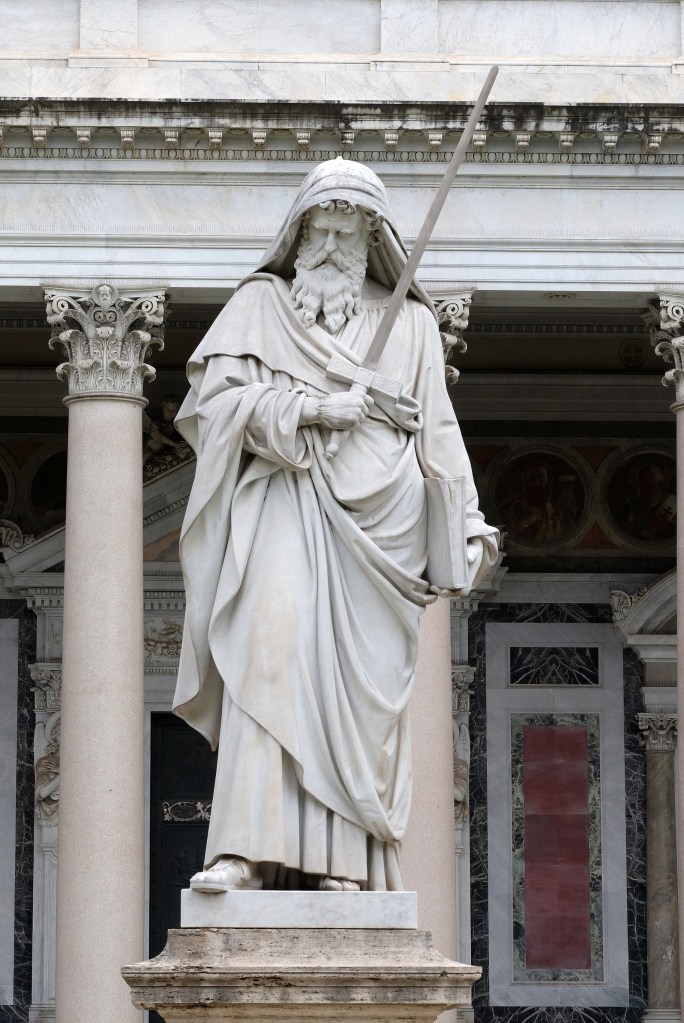
The Epistle reading, Romans 13:8-14, includes St. Paul’s instruction on the faithful on two topics: Love and the Expectation of the Second Coming. The first topic is addressed in verses 8 to 10. St. Paul does not mention the first through the fifth commandments and his brevity in referring to the “thou shalt not” commandments, the fifth through tenth, does not diminish their importance. He states clearly that “love does no harm to a neighbor; therefore love is the fulfillment of the law.” In the final verses, 11 through 14, he states what has become Christian doctrine: “now is the time to awake out of sleep, for now our salvation is nearer than when we first believed.” The verses mean that the expectation of the Second Coming remains ever-present in the “now. ” St. Paul also draws a sharp comparison between the ever-present “works of darkness” for which preparation is putting on “the armor of light,” both phrases are also used in the Collect for the day. Verses 13 and 14 remain sound advice concerning proper Christian behavior. St. Paul’s advice is one of several Scriptural sources which inspired the development of the Christian understanding of virtues and vices (the latter being the opposites of virtues) that was developed in the fourth through the seventh century.
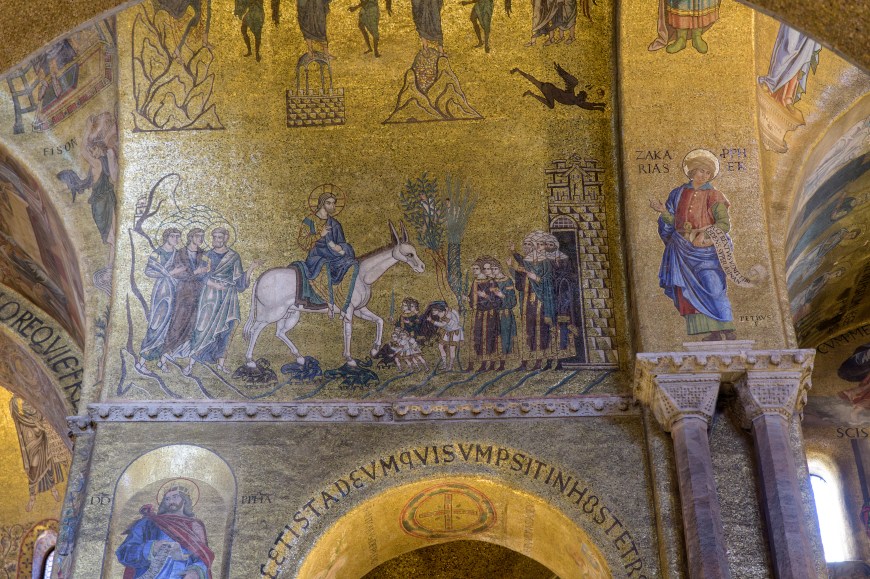
The Gospel reading, Matthew 21:1-13, is St. Matthew’s account of the Triumphal Entry into Jerusalem on what is now called Psalm Sunday. These verses are usually read in other liturgical denominations on Palm Sunday. In his commentary in the Book of Common Prayer, church historian Massey Shepherd explains that the reading was selected for its symbolic and not its historical meaning. Shepherd describes the verses as an account of Christ coming as “King and Messiah in the midst of his own people and into Sion, the holy city and His temptation.” In some other liturgical denominations the reading from Matthew is part of a rotation through several Gospel readings. In that system, Matthew 21:1-13 is not read every year. The details of Jesus’ instruction in verses 2 and 3 influenced artists depicting the entry in mosaics, icons, frescoes and other media (see the notations below in Other AIC Resources). Although the Scripture verse refers to “branches,” palm leaves are the most common in depictions of the event. In some regions, depending upon what plants are available locally, other plants, such as pussy willows, are used. The use of palms may have been influenced by the Roman Empire practice of throwing palms in the path of returning warriors. The account by St. Matthew also includes the memorable phrase: “Hosanna to the Son of David. Blessed is he that cometh in the name of the Lord. Hosanna in the highest” (verse 9), a phrase based upon Psalm 118:26. The reading closes in verses 12-13 with an account of Jesus cleansing the Temple, which includes Jesus’ citation of Isaiah’s condemnation of improper use of the Lord’s temple: “It is written, My house shall be called the house of prayer; but ye have made it a den of thieves” (Isaiah 56:6).
Other AIC Resources on topics in this post: The Collect, Epistle and Gospels readings for First Sunday in Advent are discussed and illustrated in Episode One in the AIC Christian Education Video series, Advent: A Season of Penitence & Preparation. The audio-only version in MP3 format is linked from the Podcast Archive page. My Podcast Homily for First Sunday in Advent is linked from the Podcast Homilies page. Another Podcast Homily, this one based on the Psalm reading for Morning Prayer on First Sunday in Advent is linked from the Podcast Homilies-Morning Prayer page. St. Matthew is the subject of Episode Fourteen and St. Paul the subject of Episode Five in the AIC Christian Education Video series, The Lives of the Saints, First Series, celebrating the 18 saints with Holy Days or shared Holy Days in the 1928 Book of Common Prayer. Audio-only versions of both episodes in MP3 format are linked from the Podcast Archive page. Other depictions of the Triumphal Entry into Jerusalem in AIC Bookstore Publications include a circa 1140 interpretation from the Pericope Book of St. Erentrud at Salzburg, which is Illustration No. 94 in The Gospel of Matthew: Annotated & Illustrated; a 6th C. illumination in colors and gold from the Rossano Gospels is Illustration No. 92 in The Gospel of Luke: Annotated & Illustrated; a 4th Qtr, 12th C-1st Qtr, 13th C. illumination from the Oxford Psalter is Illustration No. 62; a Byzantine-style mosaic from the 12th C. in the Palatine Chapel, Palermo, Sicily, is Illustration No. 63; and an early 14th C. fresco by Giotto di Bondini at Scrovegni Chapel, Padua, Italy, is Illustration No. 64 in The Gospel of John: Annotated & Illustrated. Finally, in The Layman’s Lexicon: A Handbook of Scriptural, Theological and Liturgical Terms, relevant entries include Advent, Collect, Gospel, Grace, Immortality, Light, Mercy/Merciful and Virtue(s). All the AIC Bookstore Publications are offered exclusively through my Amazon Author Central page. 100% of all royalties from the sale of AIC Bookstore Publications are contributed to the AIC.
As always, thank you for your interest and support. Glory be to God for all things! Amen!


Published by